
Don't start every PostgreSQL deployment from the same defaults

One of PostgreSQL's strengths is its flexibility.
The same database platform can support transactional applications, geospatial workloads, time-series data, analytics, and other specialized use cases.
But getting from a standard PostgreSQL installation to a workload-specific environment can require much more than enabling a single extension. Teams may need to select and install multiple extensions, configure PostgreSQL parameters, tune workload-specific settings, and maintain those components over time.
123Cluster turns that work into reusable Specialized Instance Templates.
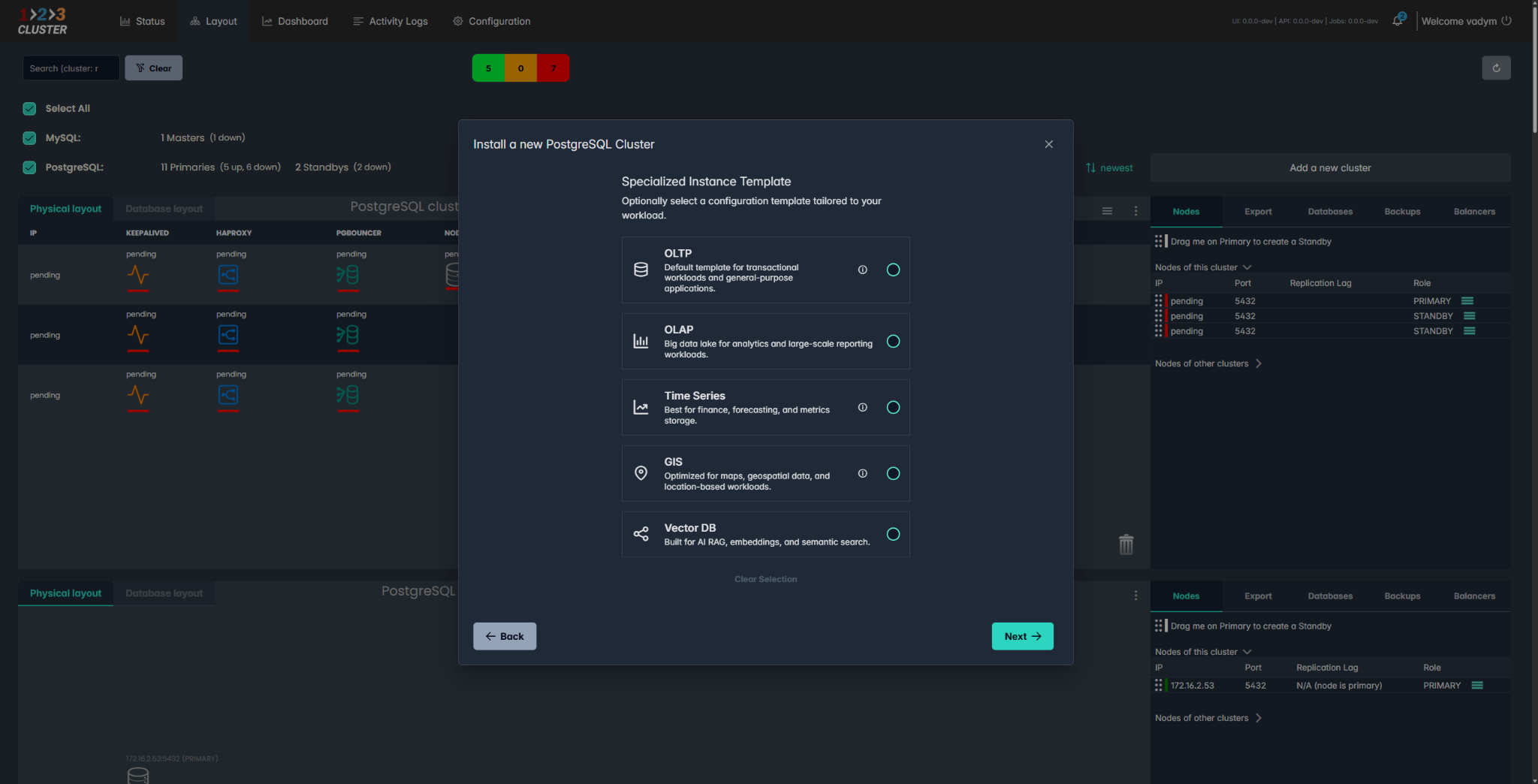
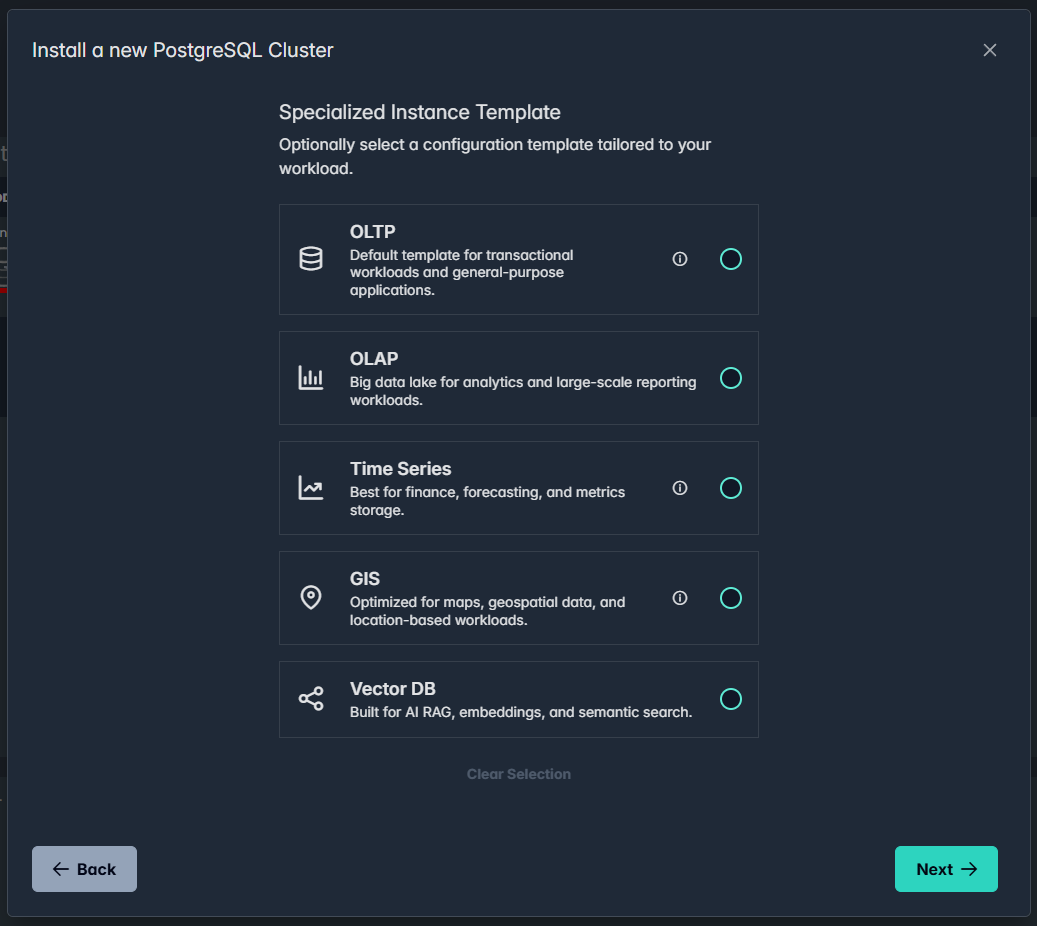
Choose the workload you need, and 123Cluster applies the corresponding extensions, tools, and PostgreSQL configuration as part of the deployment.
OLTP
For transactional applications
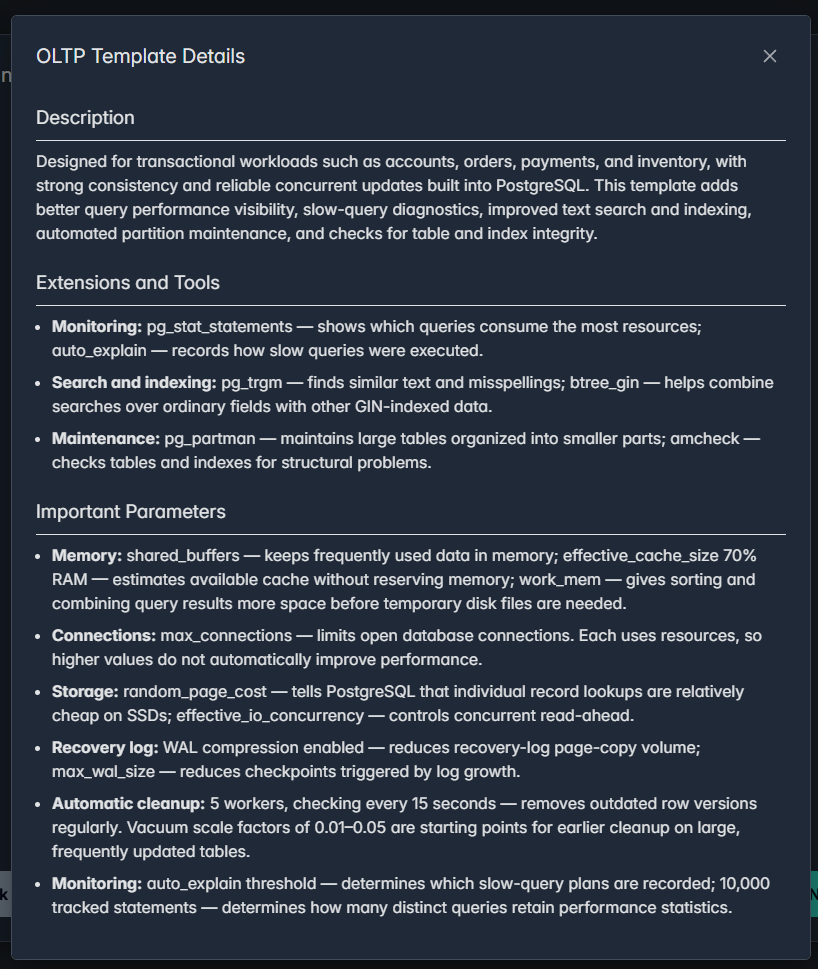
The OLTP template is designed for workloads such as accounts, orders, payments, and inventory, where applications perform frequent concurrent reads and updates.
It adds tools for query monitoring and diagnostics, search and indexing, partition maintenance, and database integrity checks.
Included extensions and tools include:
pg_stat_statements · auto_explain · pg_trgm · btree_gin · pg_partman · amcheckThe template also applies workload-oriented settings across memory, connections, storage, WAL, automatic cleanup, and monitoring.
PostGIS
For geospatial applications
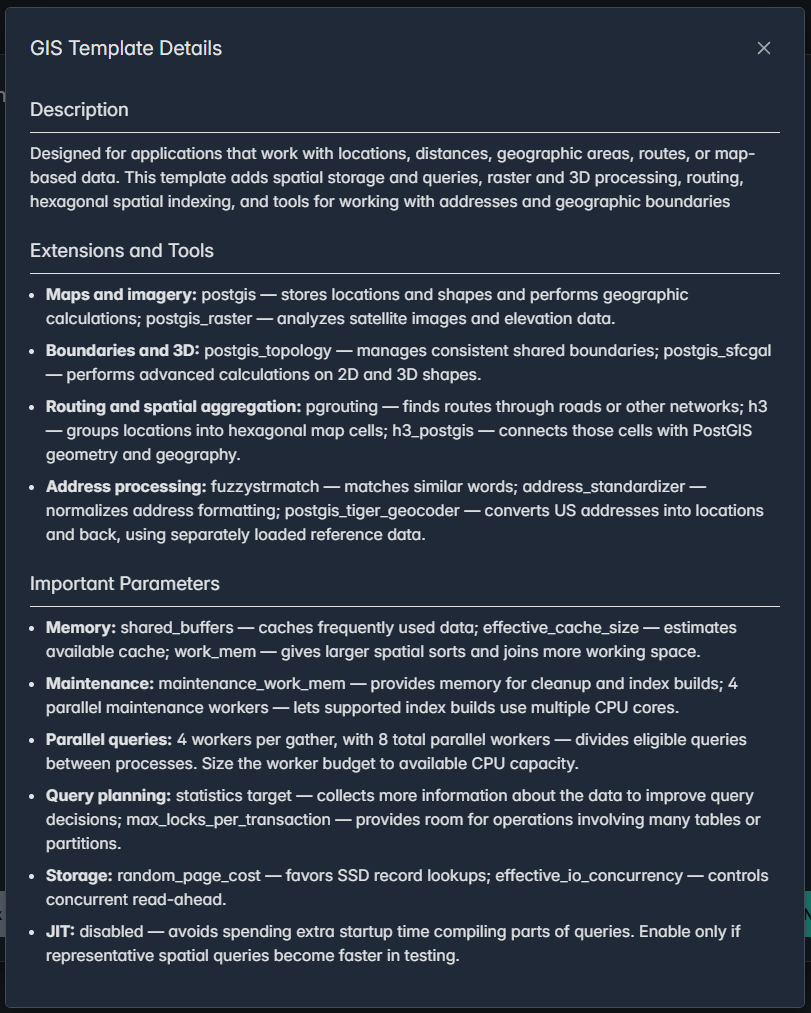
The PostGIS template is designed for applications working with locations, distances, geographic areas, routes, maps, raster data, and geographic boundaries.
It combines PostgreSQL with a broader geospatial toolset, including:
postgis · postgis_raster · postgis_topology · postgis_sfcgal · pgrouting · h3 · h3_postgisIt also includes tools for address processing such as fuzzystrmatch, address_standardizer, and postgis_tiger_geocoder.
123Cluster applies additional PostgreSQL settings for memory, parallel queries, maintenance, query planning, storage, and other characteristics relevant to spatial workloads.
Time Series
For continuously collected data
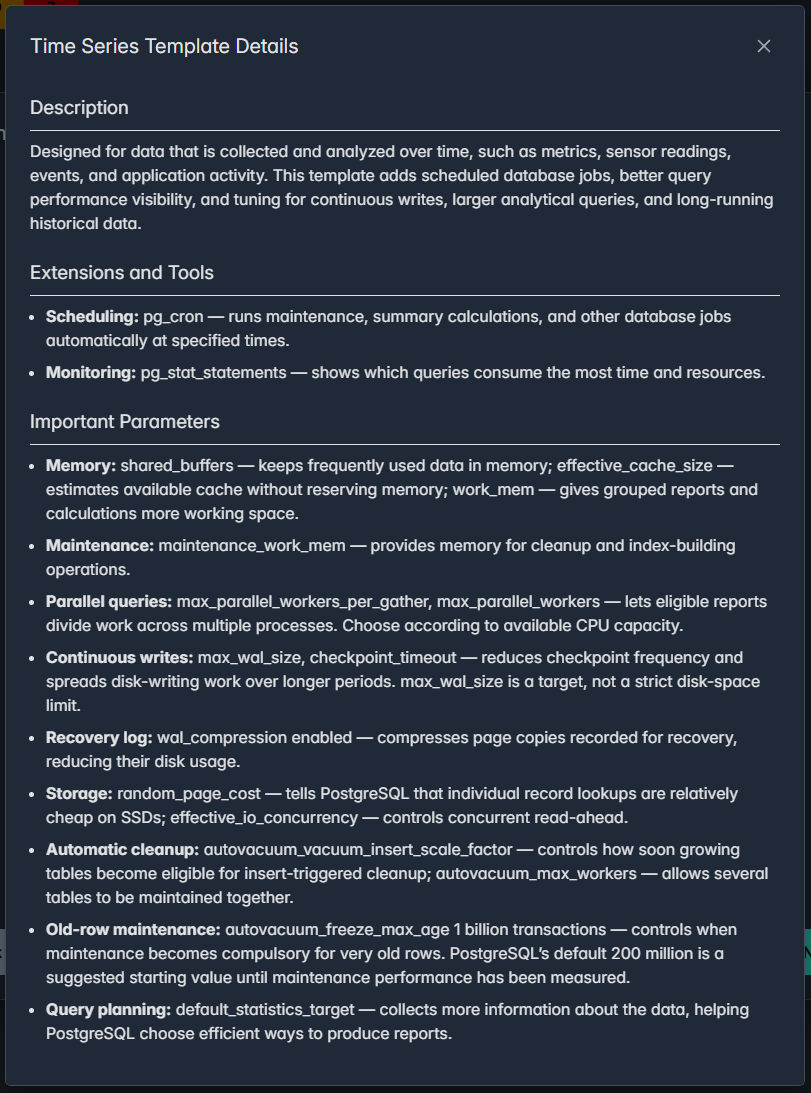
The Time Series template is designed for data that is collected and analyzed over time, including application metrics, sensor readings, events, and other historical data.
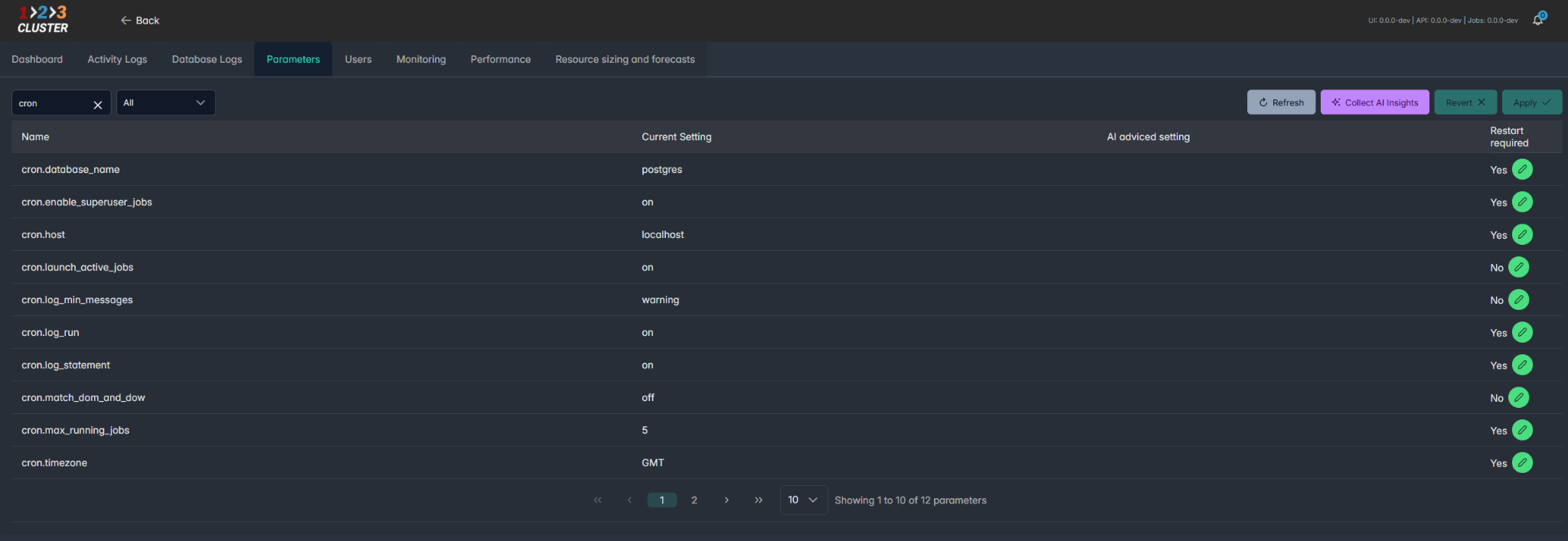
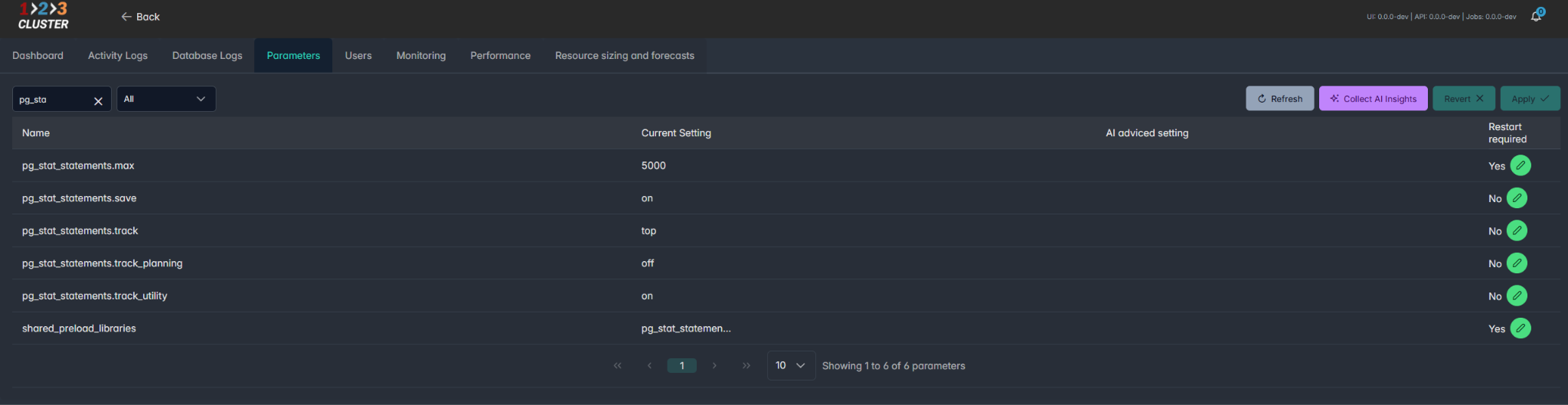
The template includes pg_cron for scheduled database jobs and pg_stat_statements for query-performance visibility.
It also configures PostgreSQL for characteristics associated with time-series workloads, including continuous writes, larger analytical queries, parallel execution, WAL and checkpoint behavior, autovacuum, storage, and query planning.
More than an extension installer
The important difference is that a preconfigured instance is not simply PostgreSQL with an extension enabled.
Each template combines three layers:
Extensions and tools → PostgreSQL parameters → workload-specific configuration
That means teams don't have to rebuild the same configuration process every time they deploy another database for the same type of workload.
Available templates
Currently available:
OLTP · PostGIS · Time Series
Additional templates for OLAP and PostgresML/AI are under development.
The current template-selection UI already shows the broader set of specialized workload options.
Why it matters
PostgreSQL gives teams a broad ecosystem of extensions and configuration options, but that flexibility also creates operational work.
123Cluster packages repeatable workload-specific configurations into the database deployment process, helping teams use PostgreSQL for specialized workloads without manually rebuilding the extension and tuning setup for every new instance.